The Language of Play: How Children "Speak" Their Feelings Through Imagination and Art
If you’ve ever tried to sit a frustrated seven-year-old down to "discuss their day," you probably know how that story ends: a shrug, a "fine," or perhaps a sudden interest in the rug's texture. For children, the vocabulary for complex emotions like anxiety, grief, or inadequacy simply hasn't finished loading yet. While adults use words to process the world, children use play.
When parents begin the search for
By utilizing art, movement, and imagination, children can finally explain "big feelings" they don’t yet have the syllables to describe.
Why Words Aren't Enough: The Developing Brain
To understand why play therapy is so effective, we have to look at the "wiring." In childhood, the brain’s prefrontal cortex—the area responsible for logic, reasoning, and verbal expression—is still very much under construction. However, the amygdala—the brain’s emotional smoke detector—is fully operational from birth.
This creates a developmental gap. A child can feel a massive wave of panic or frustration, but they literally lack the neurological "hardware" to translate that feeling into a coherent sentence.
The Stress Response: When a child is overwhelmed, they often enter a "fight, flight, or freeze" state.
Verbal Blockage: In this state, the verbal centers of the brain often shut down, making traditional "talk therapy" nearly impossible.
Symbolic Communication: Play bypasses the verbal brain and speaks directly to the emotional brain through symbols and metaphors.
The Toolkit: How Imagination Becomes Communication
In a play therapy room, the "tools" aren't just toys; they are specialized instruments of expression. Here is how children use different mediums to communicate:
1. The Power of "Third-Person" Projection
Directly asking a child "Why are you sad?" can feel like an interrogation. However, if a child is playing with puppets, they might show a "Baby Bear" puppet hiding under a bed because the "Papa Bear" is shouting.
The Benefit: Projection provides a "psychological buffer." It allows the child to explore scary or painful dynamics from a safe distance. They aren't talking about themselves; they are talking about the puppet.
2. The Sand Tray: Building a World
Sand tray therapy involves a shallow box of sand and hundreds of miniature figures. A child might bury a soldier, build a fence around a kitten, or create a battle between dragons.
Spatial Representation: This allows a therapist to see the child’s internal world. If a child always puts a "wall" between themselves and others in the sand, it speaks volumes about their perceived safety and boundaries.
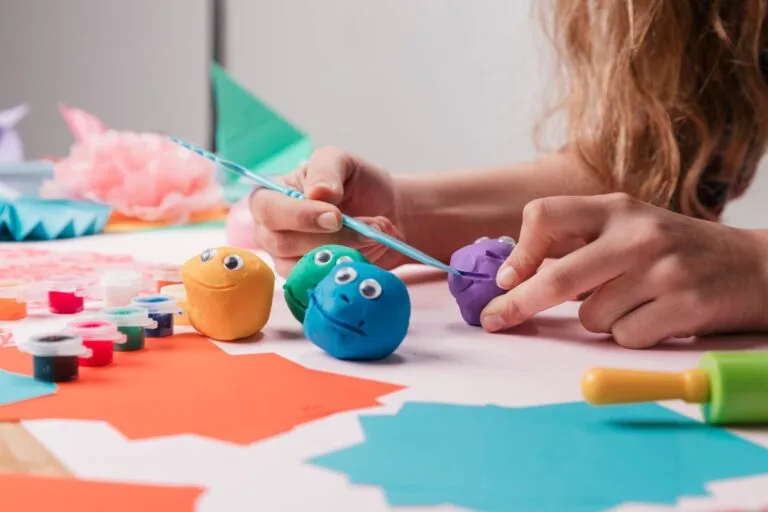
3. Art and Creative Release
Art is non-linear. A child who can't say "I feel like my life is out of control" might draw a chaotic storm with heavy, dark scribbles.
Sensory Processing: Squishing clay or using finger paints allows for a sensory release of pent-up energy. It’s a physical way to "move" an emotion out of the body and onto the paper.
Comparing Modalities: Talk vs. Play
| Feature | Adult Talk Therapy | Child Play Therapy |
| Primary Tool | Language / Narrative | Play / Metaphor |
| Brain Focus | Prefrontal Cortex (Logic) | Limbic System (Emotion/Sensation) |
| Direction | Direct questioning | Indirect observation and reflection |
| Goal | Insight and behavior change | Emotional regulation and integration |
Movement and the Nervous System
Sometimes, big feelings are stored in the body as "restless energy" or "aggression." Play therapy often incorporates movement—jumping, throwing soft balls, or even rhythmic drumming.
This isn't just "burning off steam." It is nervous system regulation. By engaging in physical play within a therapeutic setting, children learn how to move from a state of "high alert" back to a state of "calm." The therapist helps narrate this process: "I see your heart is beating fast after that game; let’s see how we can help your body feel quiet again."
The Role of the Play Therapist
A common misconception is that play therapy is just "supervised fun." In reality, the therapist is a highly trained observer who utilizes tracking and mirroring.
Tracking: The therapist narrates the child’s actions ("You're making sure the baby doll is very hidden"), which helps the child feel seen and understood.
Mirroring: The therapist reflects the child’s emotional state, helping them build "Emotional Literacy." If a child is aggressively crashing cars, the therapist might say, "That car looks very, very angry right now." This validates the feeling without shaming the behavior.
Is Play Therapy Right for Your Child?
If your child is struggling with the following, play therapy may be the most effective path forward:
Life Transitions: Divorce, moving, or a new sibling.
Trauma: Events that are too overwhelming to "talk through."
Behavioral Outbursts: Frequent meltdowns or "unexplained" anger.
Social Anxiety: Difficulty connecting with peers or extreme shyness.
By honoring the child's natural developmental stage, play therapy prevents them from feeling "broken." It treats their imagination as a strength, turning their favorite activities into a roadmap for healing.
Final Thoughts
As parents, we often want to rush our children into "explaining" themselves. But some feelings are simply too big for small voices. By leaning into toys, art, and movement, we give children the agency to process their world on their own terms.
At Resilient Mind, we believe that every child deserves to be understood—even when they don't have the words yet.
Written by: Resilient Mind Psychotherapy


Comments
Post a Comment